2025 SACNAS NDiSTEM Conference
Hosted by the Society for Advancement of Chicanos/Hispanics & Native Americans in Science (SACNAS), the annual National Diversity in STEM Conference brings together thousands of students, researchers, and professionals from across the country to celebrate cutting-edge science and build community among historically underrepresented groups in STEM fields. For students Josiah Chen ('26), Caden Spencer ('26), Austin Blomquist ('28), and Kaleb Ecklund ('26), this year’s conference was both a professional milestone and a great opportunity to represent Wheaton’s brand new engineering department.
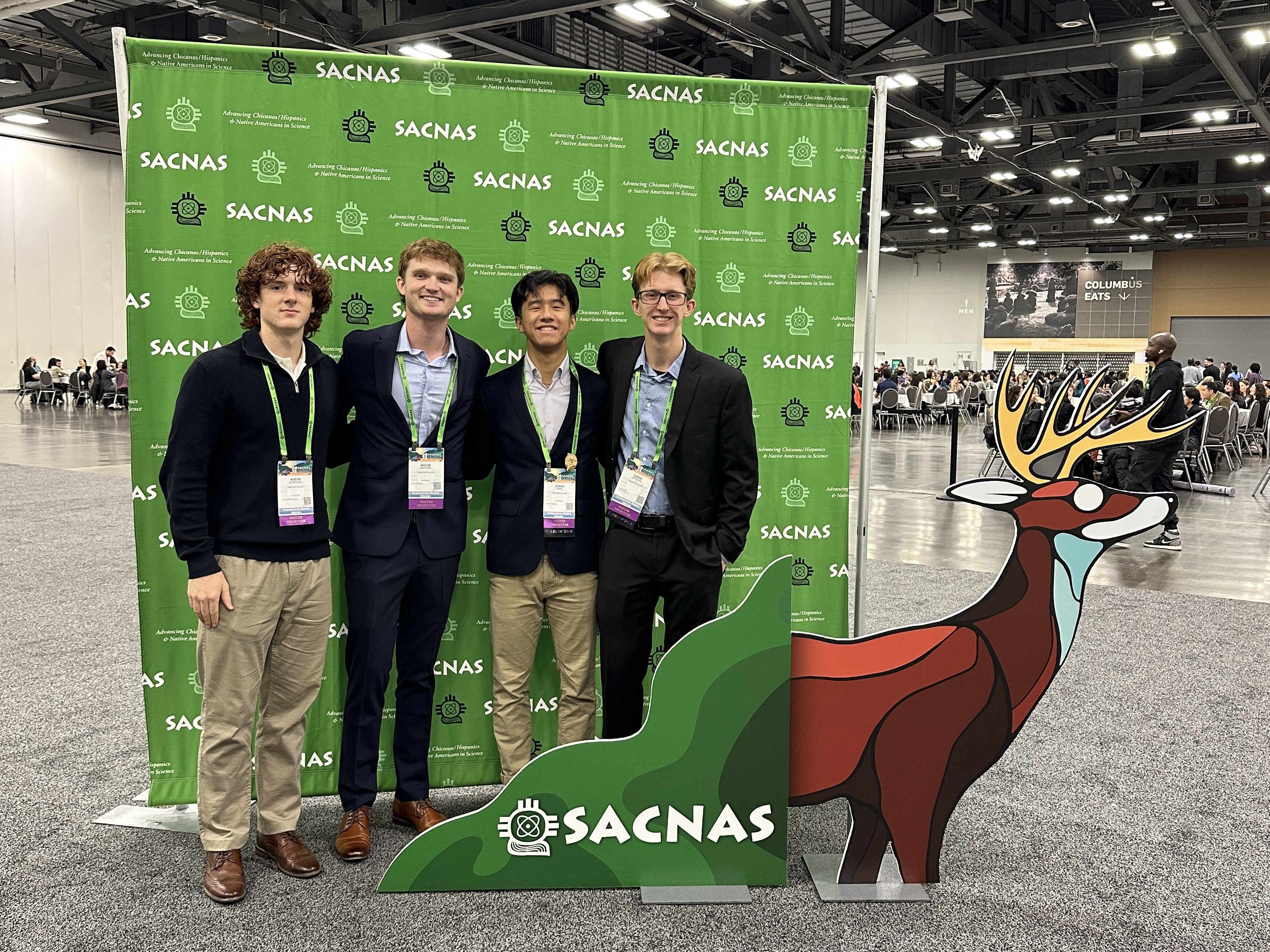
Students Josiah Chen and Caden Spencer, who are close friends, worked together on a joint research project that began in the fall of 2024 in Dr. Kelly Vazquez’s Materials Science for Engineers course. They studied the mechanical properties of Acrylonitrile Butadiene Styrene (ABS) plastic, most commonly known for its use in everyday plastic components such as phone cases, computer keyboards, and car dashboards, notably in LEGO® bricks. Their research involved looking at the relationship between color additives and the fracture behavior of specimens at varying operating temperatures. Using LEGO® beams as their test specimen of choice, Chen and Spencer collected data over the course of the semester. They found that while the operating temperature plays a large role in how the specimens stretch, color additives do not factor in. What began as a lighthearted research choice quickly became a larger project as they discovered the impact their data could have on polymer manufacturing, especially regarding plastics that function in high-temperature environments.
During the presenting session, Chen and Spencer connected with researchers from institutions across the country, gaining feedback that will help shape the next phase of their work. For Spencer, the experience allowed him to further explore an interest in pursuing a Ph.D. Engaging in in-depth conversations about methodology, long-term research questions, and potential collaborations gave Spencer a clearer vision of what doctoral-level research could look like. Chen, meanwhile, left the conference feeling certain that he wanted to pursue a master’s degree in materials science engineering. Through conversations at the graduate school fair and during the poster session, Chen explored programs that would allow for advanced technical training while maintaining flexibility in career direction.
For senior Kaleb Ecklund, NDiSTEM gave him a chance to present his work on how the cellular environment influences the function of islet cells, which play a critical role in insulin secretion. His research focused on how substrate stiffness affects cell behavior, using calcium signaling as a measure of cellular activity. By testing cells on materials ranging from soft hydrogels to rigid glass, Ecklund found that there is an optimal level of stiffness that maximizes cell function. The findings, while still exploratory, have important implications for tissue engineering, particularly in efforts to develop engineered pancreatic tissue or improve treatments for diabetes.
The conference also marked Ecklund’s first time presenting his research, an experience he ultimately found rewarding. Sharing his work helped build his confidence, and the event provided valuable networking opportunities as he explored PhD programs. Conversations with representatives from schools such as Georgia Tech proved especially influential, contributing to his decision to attend the program after being accepted. He also connected with researchers from other universities, expanding his perspective on potential academic paths and reinforcing his enthusiasm for continuing in the field.
Blomquist’s research project investigated how the mechanical environment of pancreatic β-cells influences their behavior and function.The study explored whether physical cues, specifically substrate stiffness, also play a role in cellular activity. Using mouse islet cells, the Blomquist focused on F-actin, a cytoskeletal structure that acts as a force transducer and is involved in cellular remodeling. Results showed a noticeable increase in cellular protrusions and F-actin intensity at higher stiffness levels (around 33 kPa), suggesting that stiffer environments may enhance cytoskeletal activity. Although the data is not yet conclusive, the findings point toward a potential link between mechanical stiffness and β-cell behavior. His research contributes to a broader understanding of how changes in pancreatic stiffness, commonly observed in individuals with diabetes, may influence cell dysfunction in diseases like Type 1 and Type 2 diabetes.