
/prod02/channel_1/t4_pending/media/hngr/Kalantzis-Reflection-Header.png)
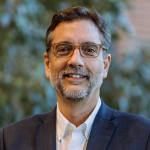
Dr. George Kalantzis
Stories, small and grand, sustain our communities and frame and shape the realities we inhabit, the world we receive. Stories interpret our past to form our future. Stories are perception-formative, they are identity formative. In I Saw Ramallah, Palestinian poet Mourid Barghouti reminds us of the power of stories to also dispossess people: “It is easy to blur the truth with a simple linguistic trick,” Barghouti notes, “start your story from ‘Secondly’... and the world will be turned upside-down. Start your story with ‘Secondly,’ and the arrows of the Red Indians are the original criminals and the guns of the white men are entirely the victims. It is enough to start with ‘Secondly,’ for the anger of the black man against the white to be barbarous. Start with ‘Secondly,’ and Gandhi becomes responsible for the tragedies of the British.”[1]
Start the story of people on their migratory journey with the crossing of immigrants, migrants, asylum-seekers, or refugees from their ancestral lands to their current resettlement, and we lose the war-torn villages, the famines that killed thousands, the fields and rivers rendered poisonous by the greed of multinational corporations that pollute and destroy the land in search of profit, the generational oppression and war that disinherited the rest. Start with the powerlessness of the survivors, now dispossessed from one’s ancestral home, with arms stretched in search of help, and we will never see anything else.
Start with ‘secondly,’ and we miss the beauty, the goodness, the eloquence, the artistry, the intellect, the capacity, the faith, love, and hope. Start with ‘secondly,’ and we lose our culpability in the economic, political, religious, and social systems that have created and continue to contribute to the global nexus of oppression and exploitation causing hunger, conflict, and disease, the manifest causes of displacement throughout the globe. Start with ‘secondly,’ and we lose the fact that poverty and hunger are the result of our own choices, that neither is unavoidable, and that both can be reversed and resolved in our lifetime.
Start with ‘secondly,’ and people become a single story; they are dispossessed and they become ‘other.’ The Nigerian writer Chimamanda Ngozi Adichie speaks of the danger of ‘single stories’ and the markers of power operative in them. “Power is the ability not just to tell the story of another person, but to make it the definitive story of that person,” says Adichie. “The consequence of the single story is this: It robs people of dignity. It makes our recognition of our equal humanity difficult. It emphasizes how we are different rather than how we are similar.... Stories matter. Many stories matter. Stories have been used to dispossess and to malign, but stories can also be used to empower and to humanize. Stories can break the dignity of a people, but stories can also repair that broken dignity.”[2]
The Gospel restores the dignity of people as image-bearers of God. From beginning to end, that is the Christian story. And that is exactly why the work of Memoria Indígena is so crucial to the renewal of God’s kingdom– for stories told properly restore dignity. This summer we had the opportunity to see again the unwavering commitment of people standing against the ‘powers of the World,” committed to see others as image-bearers of God.
From La Tagua, Santa Marta, and Magdalena, to Cali, and Medellín, local coordinators of Memoria Indígena, working in partnership with leaders from the Wiwa, Nasa, and Embera peoples, invited us, a small team from Wheaton College, in N. America, to accompany them as they stood in solidarity with those whose territories have been shattered, whose lands have been devastated, with communities and peoples have been dispossessed for generations in the search of profit and in the name of ‘progress’– people whose languages and customs and way of life continues to be under threat. From the poisoned fields of the north to the open-air refugee camps of Medellín, we bore witness to the plight of indigenous peoples and to the hard work of Christians who have taken seriously the unique responsibility to reverse this “othering,” this generational dispossessing. We bore witness, to the efforts of our brothers and sisters to restore broken dignity and become the welcoming communities within which persons can move on the path of regaining the humanity that has been stripped from them.
For a short few days this summer we were invited to bear witness once again to the social significance of the gospel. We bore witness to the work of Christian communities who have committed to re-examine continuously the narratives we tell about ourselves, others, the Good News, and God. We bore witness to the work of Christians who recognize that their story begins with ‘Firstly,’ not ‘Secondly.’ For, “in the beginning,” is the God who is love (1 John 4:7), the God who loves (John 3:16), the God who creates human beings to be bearers of God’s own image (Gen 1:26-27). These are indeed Good News to the survivors, the dispossessed, to all who continue to be dehumanized by the power of the powerful.
Theology
Reflection written as part of Stott Fellows 2024
[1] Barghouti, Mourid. Ra’aytu Ram Allah (I Saw Ramallah). Translated by Ahdaf Soueif (Cairo: The American University, 2000), 178.
[2] Adichie, “The Danger of the Single Story.”