Let Us Have Athletics
As Wheaton prepares to break ground on a major athletics facility renovation, take a look back at the many places our athletes have occupied through the centuries.
Words: Bethany Peterson Lockett ’20
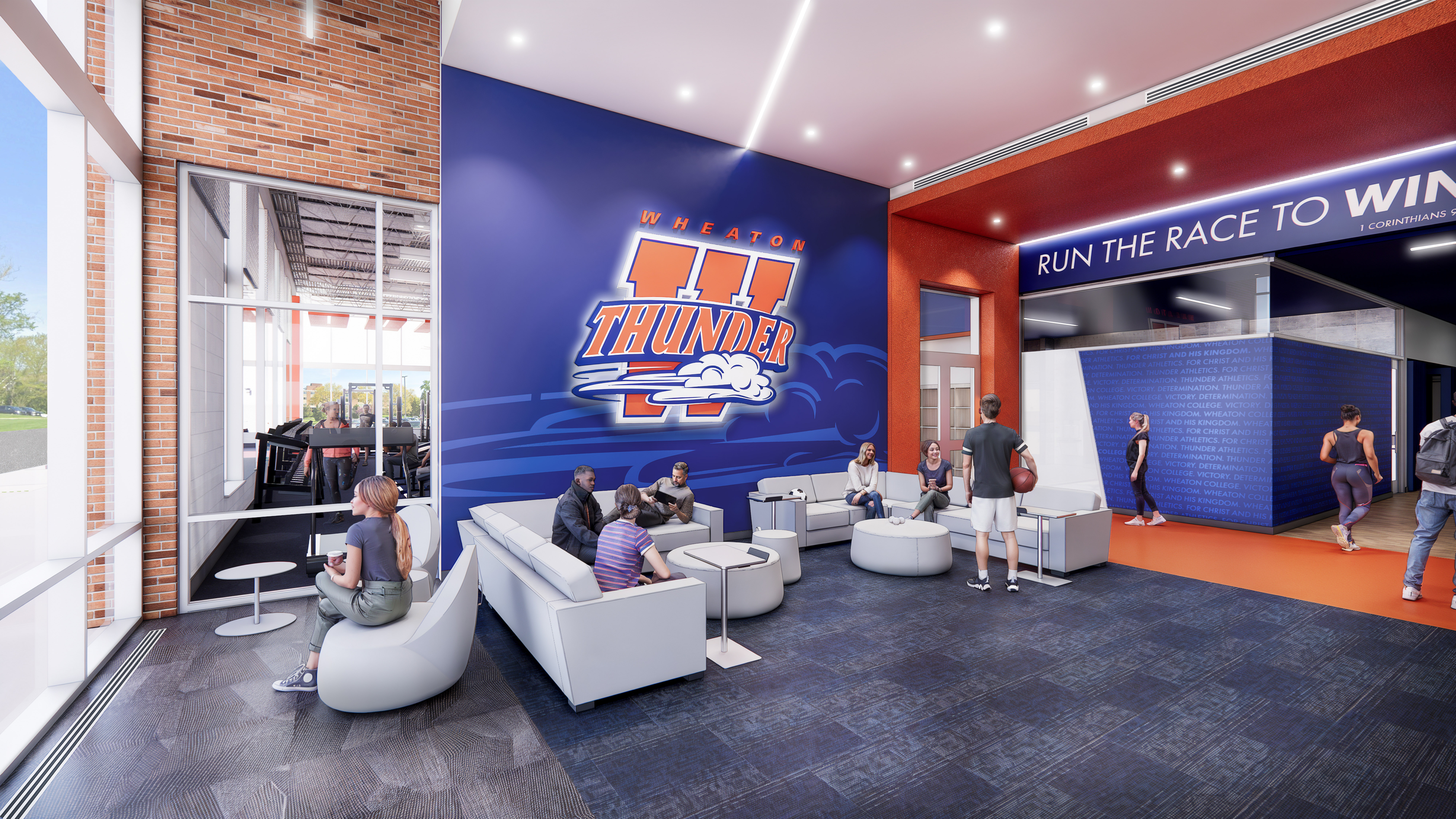
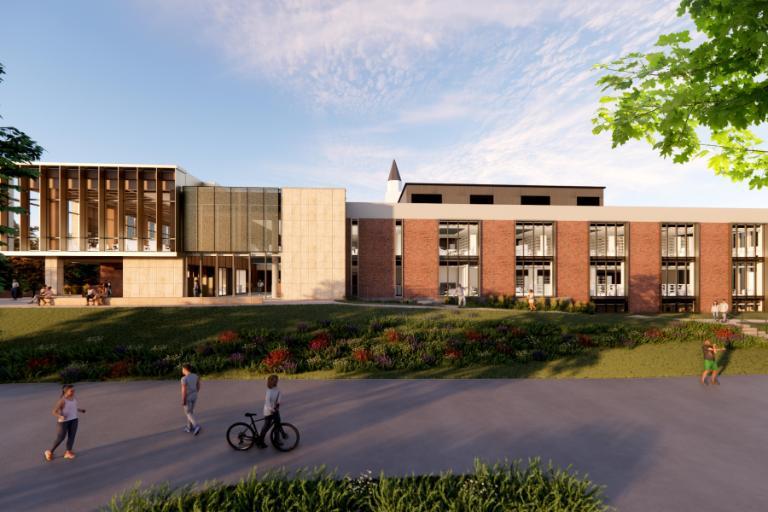
Architect rendering of the new lobby to be built in Chrouser Sports Complex.
On the second floor of Adams Hall, a low-ceilinged studio is lined with long wooden tables and metal stools. In the corner, a heavy print machine sits next to cabinets stuffed with art supplies; a metal rack holds drying papers. On the far wall, three rectangular windows illuminate a shiny, pale-colored, narrow-laned wood floor with the traditional black markings of a basketball court.
Built in 1899, the original campus gymnasium included a basketball court (built only seven years after the game’s invention), an elevated indoor track, and a basement bowling alley. Named Adams Hall in honor of John Quincy Adams (cousin to the U.S. president of the same name), who funded construction, the three-story brick building now houses the art department. “It’s good stewardship if you can reuse a building,” said Bruce Koenigsberg hon, semi-retired Wheaton architect of over 40 years. On an 80-acre campus, no inch goes to waste, but “our primary philosophy is to preserve the history and the aesthetics of the College to fit the educational needs of our students.”
Wheaton has built three gymnasium complexes, along with a number of facilities for athletes to practice and compete in, such as McCully Stadium, Bean Field, Lawson and Leedy Fields, the tennis courts, and Lederhouse Natatorium. Each older building has been repurposed, preserving the original flooring or exterior design to keep Wheaton’s legacy intact through its 165 years.
“I appreciate whoever had the wisdom to preserve the gym floor, which is now an art studio, because we bring recruits up there all the time,” said Athletic Director and Head Men’s Basketball Coach Mike Schauer ’93, M.A. ’96. “I don’t know that anybody’s made a decision to attend Wheaton because we have an old gymnasium on campus, but it’s kind of cool for them to see.”
Although the buildings’ history may not sway a new recruit, the renovation plans included in the Faithfully Forward campaign just might. Like the gymnasiums of the past, the blueprints preserve working facilities and Wheaton history while introducing modern design elements that will be functional for years to come.
FROM HUMBLE BEGINNINGS TO NEW HEIGHTS
“Good students only are wanted. Persons who wish to spend their time in sports or social recreations are advised to remain at home until they wish to study or go elsewhere.”
Wheaton’s second president, Charles Blanchard, wrote these words in 1892 in response to a group of students raising support for athletics on campus after hosting the first athletic event, an interclass track meet, in 1891. Despite Blanchard’s initial misgivings, Wheaton Athletics were formalized with a basketball team in 1900. That same year, the baseball team began playing on Lawson Field.
In 1914, the first “Physical Director for Young Men,” Jasper Turnbull, published a defense of athletics in the Wheaton Record. “We do not argue that we desire the modern man to be a beef-eating Spartan or a Horatius, lopping off heads by the dozen,” he wrote. “But we do think it desirable that the modern man exercise more or less so that his blood stream will be strong, so that his brain cells will be nourished, so that he can think. Therefore, let us have athletics. It is the only logical conclusion.”
Students must have agreed. Even beyond varsity sports, roughly 44 percent of the student body today participates in intramural or club sports, which became an integral aspect of campus culture as early as the 1920s, from archery to wrestling.
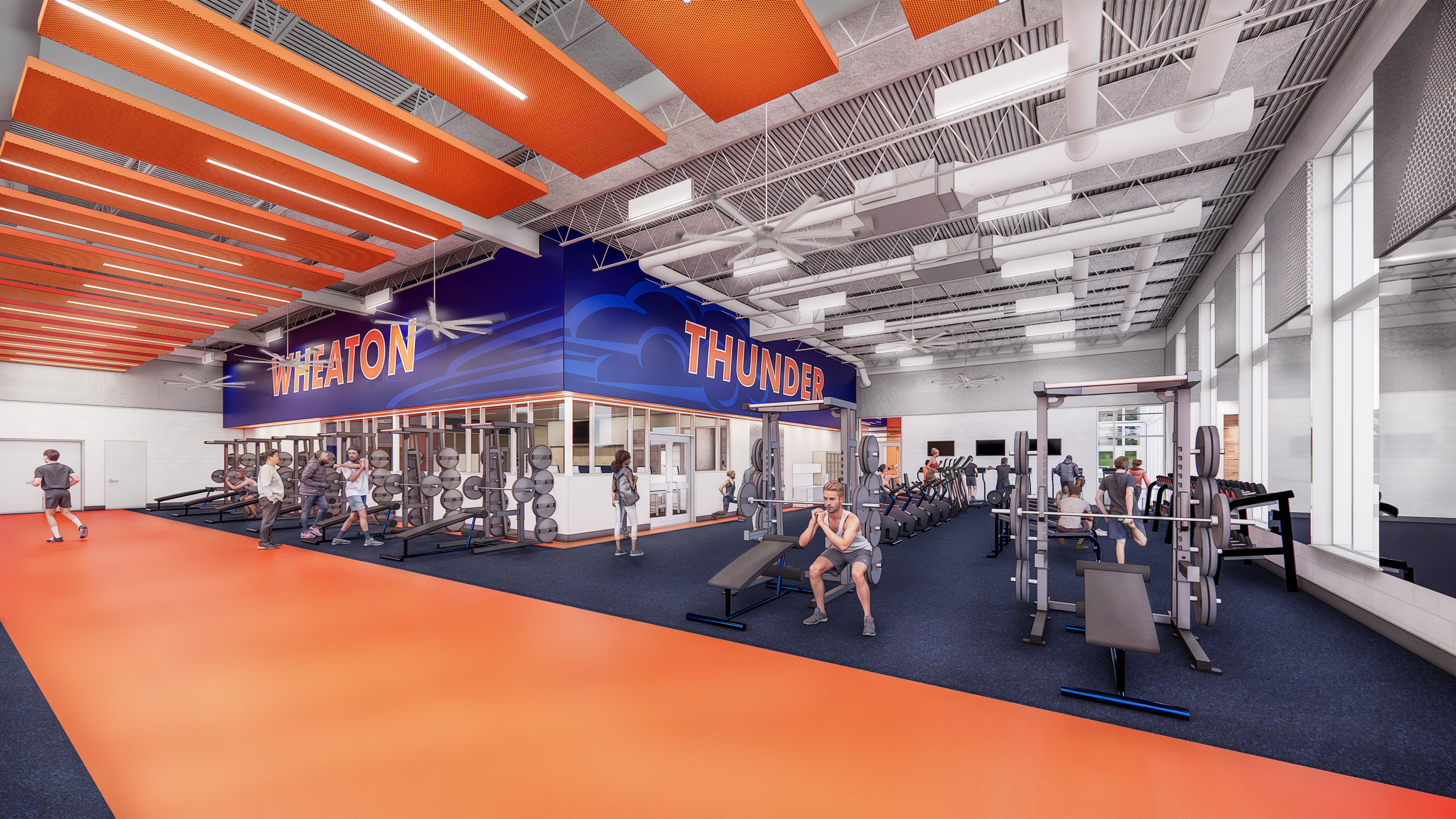
Architect rendering of the new strength and conditioning room for Wheaton athletes.
In the 1930s, ambitious plans for a new gymnasium and swimming pool fell short of funding, so President Raymond Edman tasked coaches Ed Coray 1923 and Harve Chrouser ’34 to design a more modest proposal. In 1941, during a soccer tournament in Maryland, Chrouser saw a gymnasium that seemed like it could work for Wheaton. With permission, he brought back blueprints and presented them to Wheaton leadership. When a trustee asked who would pay for it, Chrouser replied that the alumni would. He was right. Wheaton alumni raised $85,000 for Alumni Gymnasium in less than three months, and the building was completed in 1942.
The new gymnasium featured a pointed exterior with four redbrick columns and three rectangular entrance doors framed by glass windows. Inside and through the lobby, a modern-size basketball court held folding bleachers on opposing walls. A handball court, wrestling practice gym, and weight room were in the basement.
“We didn’t have standing room because the boundaries for the court went right smack up against the bleachers, practically just enough room to walk,” remembered Ray Smith ’54, former sports information director at Wheaton and cofounder (with Chrouser) of the Wheaton Athletics Hall of Honor. Due to the court’s tight quarters, a 12-instrument pep band played from a platform above the stairs to the locker rooms. “You got a huge sound in there, and the teams responded to that kind of support,” Smith said.
Coached by Lee Pfund ’49, Wheaton’s men’s basketball of this era was one of the most successful teams in Wheaton’s history. They won Wheaton’s first NCAA Division III championship in 1957.
Besides Alumni Gym, Smith described a several-acre parcel four blocks north of campus named Old Lawson Field with a baseball diamond on the west side and soccer goals on the east. Before the annual homecoming game each year, students would build a 25-foot-high bonfire pyramid of railroad ties at the far corner of what’s now McCully Field, updated in 1956 and named for football captain Ed McCully ’49. “It would never happen in today’s safety environment,” Smith laughed. “But that was an era that added a lot of excitement, color, and enthusiasm to the games.”
THE CENTENNIAL ERA
By 1958, Wheaton had decided to include a gym expansion as one of two projects during the centennial expansion campaign. But when Centennial Gym’s doors opened for the first time, it was not for a basketball game or wrestling match—but a Billy Graham Crusade. In the last week of September 1959, the campus welcomed over 100,000 visitors for the events. The gymnasium was filled, and the overflow crowds spilled into a nearby field where Fischer Hall now sits, facing the entrance to a low, rectangular building with a speckled glass entrance, flags billowing in the wind, and giant block letters spelling out 100 years and For Christ and His Kingdom.
It doesn’t take a historic crusade to fulfill the College’s motto. Discipleship and competition have always coexisted and strengthened each other in Wheaton sports history.
As a former Wheaton football player, longtime coach, and retired postmaster, Jeff Peltz ’81 has fond memories of competing on the gridiron but also of Friday football chapels with the team. “We would all stuff into this little room,” said Peltz, who now serves as the Associate Director of Development for Athletics. “It was maybe 75 of us, and we’d have a senior give some kind of challenge, and then seniors would take turns, a couple every week, sharing their story.” Football chapel was a tradition long before Peltz came to Wheaton, and he continued to invest in it as a coach for over 43 years. “I think it’s the next best thing we do besides playing a game on Saturday,” he said. “Athletics are a camaraderie builder. They’re a rallying point. When you get the core part of the heart of your athletes, they can show how much they love each other by how hard they play and how they push each other toward Jesus.”
That is not to say that Wheaton athletics has not been successful. In fact, men’s and women’s varsity teams have won 228 CCIW championships (the second-highest in CCIW history) and 6 Division III national championships. In addition to the more than 400 players recognized as All-Americans, individual athletes have brought home 37 NCAA championships throughout the years.

Architect rendering of the new athletic training room.
The move to Centennial Gym also coincided with a key period in women’s athletics history. When the new building opened, the old space from 1942 became a women’s gymnasium, renamed to Edward A. Coray Gymnasium in 1968.
Women’s athletics have a vibrant history at Wheaton, but the CCIW conference didn’t officially sponsor them until 1985. In the 1940s, women participated in “Playdays,” featuring multisport competition with other local colleges, and by the 1960s a group of dedicated female coaches and advocates—including Chrouser’s wife, Dorothy McDonald Chrouser ’34; Marilyn Scribner hon; Martha Cole Baptista ’45; and Ruth Berg Leedy ’32 (for whom the softball fields are now named)—formed the first group of varsity women’s sports: field hockey, basketball, volleyball, and softball. In 1972, Title IX opened far more opportunities for female collegiate athletes and increased investment in women’s athletic facilities.
When Head Women’s Tennis Coach Jane Nelson ’83 was a student at Wheaton, female athletes didn’t have access to the weight room. A makeshift locker room was relegated to the Coray basement. As a tennis and basketball athlete, Nelson would run up and down the stairs in Fischer Hall and sometimes work out in a glorified closet. Since then, she notes, projects throughout the years have made Wheaton athletics an increasingly welcoming environment for both male and female athletes. “All of us in the athletic department are very excited about the new facilities,” Nelson said. “We are grateful for the hard work the design team is putting into the renovation.”
By the time Nelson returned to Wheaton as a tennis coach in 1986, the women’s teams had moved to Centennial Gym and gained access to the weight and training rooms. Wheaton women’s teams have more than made up for the lost time. As of September 2025, they have won 105 conference championships, which is a CCIW record. The women’s soccer team has also brought home three Division III national championships (2004, 2006, and 2007).
THE NEW MILLENNIUM
As varsity sports grew, it was clear they needed another complex—and not just for athletes. The $15-million Student Recreation Center completed in 2000 was a different kind of gymnasium building. With high ceilings, airy skylights, and a spirited orange and blue lobby, what’s now known as the Chrouser Sports Complex made athletics more accessible to every student and the surrounding community.
According to Koenigsberg, the SRC was part of a building campaign to improve student life (along with the Todd M. Beamer Student Center next door). In 1981, the College built its first-ever swimming pool, later named the Jonathan Lederhouse Natatorium after Wheaton’s longtime swim coach, Jon ’74. Later, in 2000, the SRC project was complete with new gyms, fitness centers, and offices, and the great hall entrance to King Arena, named for donor Leroy King. The 8,000-square-foot weight room, three recreational courts, climbing wall, second-floor dance studio, and indoor track are accessible to all of campus. Paid memberships are also available to the public.
For all its improvements to campus life, the Chrouser Sports Complex did not include updates to the athlete-only facilities, most notably the locker rooms last renovated with the Centennial Campaign in 1960—a time when Wheaton had a total of ten varsity sports, none of which were women’s teams. “We have about 500 student athletes currently, and we have 414 lockers. Even I as the basketball coach can do the math; that is not enough,” Schauer said.

Architect rendering of brand new locker rooms for Wheaton teams and visiting athletes.
According to Whitley Grey, Assistant Director of Facilities Planning and Design, the upcoming renovations meet four crucial goals: expand the training room with better equipment (such as hydrotherapy) and space for treatment, provide dedicated locker rooms for every varsity team, create a new athlete-only weight room with specialized equipment (which frees up the current weight room for others to use), and add visiting team locker rooms to avoid congestion on game days.
David Stevenson ’26, a swimmer and member of the Student Athlete Advisory Committee, said he has enjoyed the Lederhouse Natatorium facilities. Because they occupy a separate pool area, the swim team has more private lockers, showers, and equipment storage. “I realized that swimming has it pretty good when it comes to the amount of space and equipment we have, which is really, really nice, especially considering the size of our team,” he said. Attending SAAC meetings made him realize the inconvenience other athletes face when they have to lug equipment across campus or leave it in unsecured spaces due to the locker room shortage.
A proponent of beauty, Koenigsberg said the plans are also about campus aesthetics. The same red brick that threads its way through campus will be used in the additions, which will be built into the north end of the Chouser building. The new athlete entrance on this addition will also create a more intuitive and comfortable experience for visiting teams and recruits.
When it comes to recruitment for her team, Nelson said that ultimately it’s the community and culture that convince students to come to Wheaton. “The biggest selling point of our women’s tennis program is the character and caliber of the young women in the program. Most of our athletic teams have been very successful over the years without A+ facilities. I’d like to think that we’re already giving our best, no matter what type of locker room we have or don’t have.”
“Whether we think they should or should not, facilities matter,” Schauer said. “I believe I was created as an athlete, and I don’t perceive that makes me any different, or at least not much different, than somebody who’s created with great musical gifts. During the last campaign, Wheaton built a beautiful conservatory, and this has a similar motivation. This is our giftedness, so we should pursue excellence in our athletics facilities too.”
Wheaton’s athletics facilities are worth preserving and expanding, not just for better sports performance in its own right, but for the sense of identity, belonging, history, and faithfulness they have helped uphold in the lives of students across the decades.
Therefore, let us have athletics. It is the only logical conclusion.
Support Wheaton Athletics.