A Library’s Lasting Value
Supporting Wheaton College’s print resources and physical study spaces may be more important than ever.
Words: Emily Bratcher
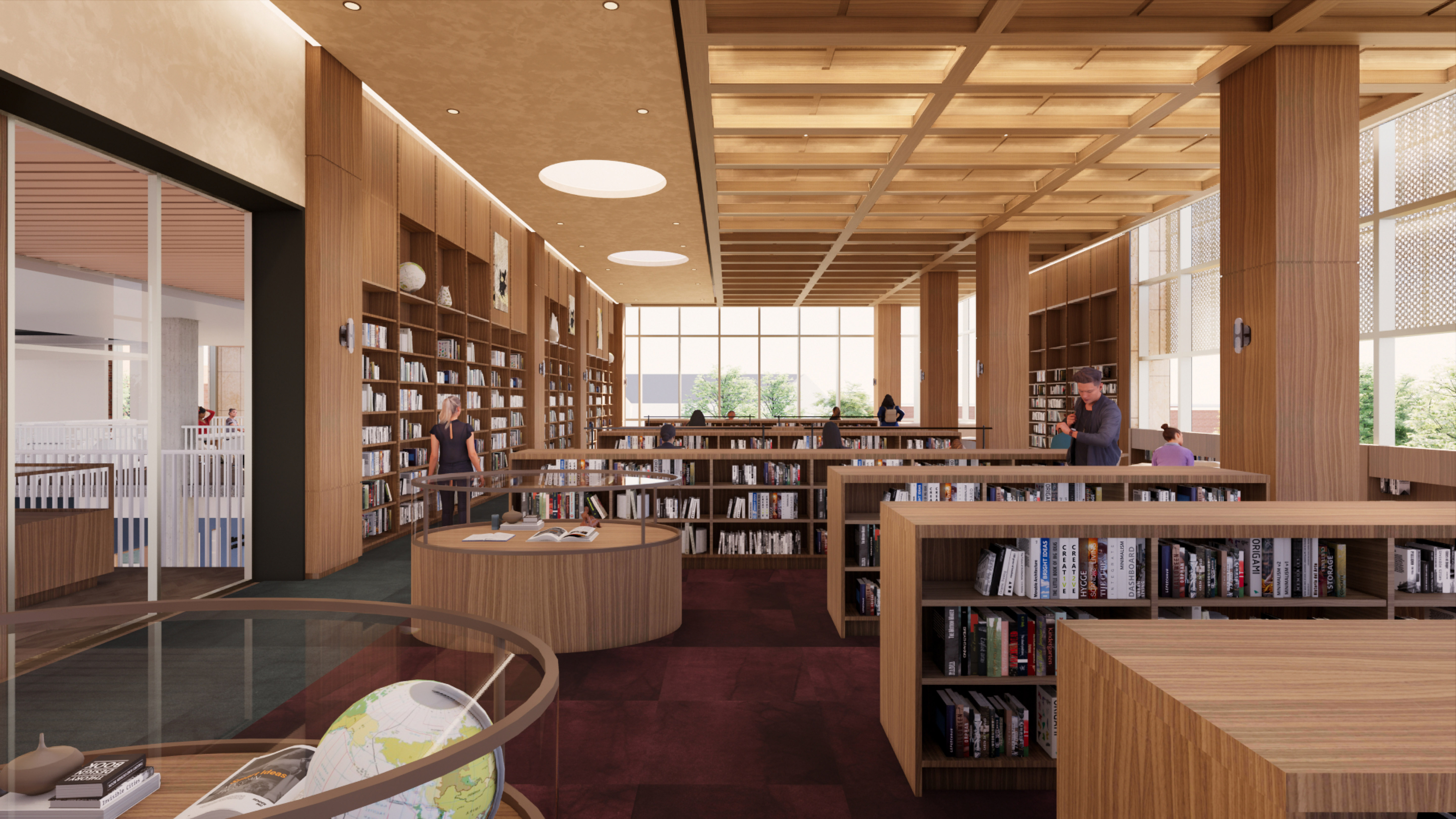
Architect rendering of the new Reading Room for the Wheaton College Library.
Nearly 75 years since students first perused its stacks, and in a higher-education landscape that values print media less and less, the Wheaton College Library is still teeming with books and other printed resources.
In fact, out of all 116 governing member schools that are part of the Council of Christian Colleges & Universities, Wheaton possesses the second-largest collection of print books—384,961 at last count. It also places second for total number of books and media in circulation.
Those titles are housed in the Wheaton College Library—a large brick building striped with windows and capped with a cement roof, in a leafy center of campus, tucked just off Irving Street between Edman Chapel and Armerding Hall. Opened in 1952, the library got an update to the north wing in 1975 during the energy crisis, which influenced its architectural design. Before the Marion E. Wade Center got its own building, its collection (including the wardrobe that inspired C. S. Lewis’s Chronicles of Narnia) also lived in the library in the Nicholas Wing.
Before that, the library’s books lived in two repositories in Blanchard Hall: the Fischer Library, located on Blanchard’s fourth and fifth floors, and the Frost Library, nestled on the east end of the second floor.
Wheaton’s collections currently occupy three floors of the library—though the main floor has perhaps fewer, holding instead the café, computer labs, offices, circulation, and diverse journals like The Iowa Review, Faith & Economics, and Percussive Notes.
There are so many books within the stacks located on the basement floor that the bookcases are sandwiched together in what’s called a compact shelving system that runs on five tracks, manufactured by a company called Spacesaver. If a scholar needs a book on a shelf that is inaccessible, he or she can move the stacks with the click of a green arrow button. Above the buttons is black signage that reads, Confirm Aisle Is Clear Before Resetting. It’s intimidating the first time, but students get the hang of it.
On those shelves, students will find titles on every topic imaginable. They’ll find The Papers of George Washington spread across 23 volumes. They’ll find an alcove dedicated to Shakespeare, adorned with a bust of the bard, along with every play and sonnet penned, as well as commentaries on it all. When arriving onto the lower floor from the stairwell, a hard-backed dictionary lies open on a pedestal.
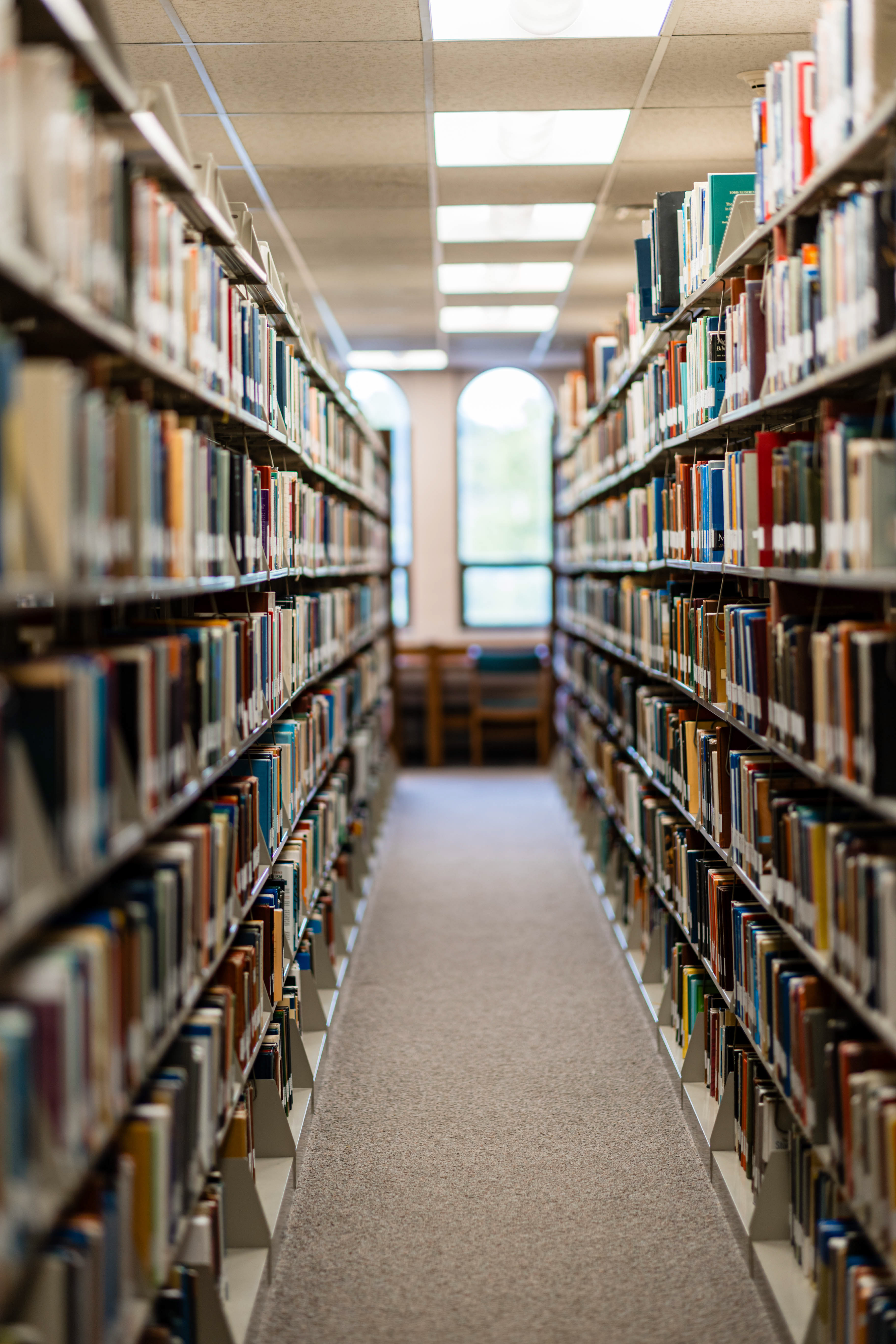
Current bookshelves in the Wheaton College Library.
Photo by Kayla Smith
Why all this focus on books?
“Researchers are finding that, for retaining information, the best pedagogical tool is the printed book, so we want to continue making space for the best teaching tools available,” says Brent Etzel, Dean of Library and Archives at the College.
Etzel is not alone in his abiding belief in the educational value of print materials. While it’s true we live in a digital age, many Wheaton College faculty, staff, students, and alumni think that the Wheaton College Library—and the campaign to support its redesign and resources—might be more important than ever.
“A library is a place that curates resources for responding to the media landscape that we’re now confronting,” says Dr. Jim Beitler, Director of the Wade Center and Professor of English. “It’s a place where there are resources to cultivate discernment around information use, and having a physical hub on campus that does that is very important.”
Countless studies have found that print is king when it comes to learning. Recent research suggests that when people continually hand off their cognitive tasks to digital tools, they’re limiting their own mind’s ability to absorb and understand complex information.
Reading on a screen versus on a page is more tiring; it creates more eye strain. Plus, if the goal of reading is to retain information, a digital version may suffice, but if it’s to think and engage with the text, a digital version is less helpful. Studies have also found that when students are reading digitally, they’ll switch away from that digital text every three to ten minutes, which decreases deep engagement with the text.
Dr. Aimee Callender, Chair of Undergraduate Psychology and Associate Professor of Psychology, has done her own research in this area, presented in “The Effects of Prior Knowledge Relevance and Organization on Text Comprehension and Memory.”
“This study looked at how the physical layout of the text contributes to a mental representation,” Callender said.
How do elements like headings, subheadings, and callout boxes within a textbook or digital text contribute to information recall? Callender found that when those formatting elements were preserved digitally, remembering where information came from between physical and digital versions was much the same. There was, however, a shortfall in recall when those elements weren’t preserved.
“Digital reading is fine for shorter texts, easier texts, and narrative texts that don’t require a lot of deep thought,” Callender said. “I’ll read articles online to get a sense of whether or not I want to read it more in depth later on, so I definitely think there’s a place for it. The biggest problem is that digital resources have replaced most of our reading, and we don’t realize that we engage with digital texts differently.”
Katherine Graber, an assistant professor of library science and team leader for the Archives & Special Collections, says Wheaton’s collection contains one-of-a-kind resources—maybe the only copy in the world or one of two copies in the world—and she often asks students who are handling materials like these: “Think about the value of this material—the object that you are holding versus a digital surrogate.”
Knowing this, many Wheaton professors send their students to the print resources shelved at the library. Each year, six figures’ worth of visitors enter the campus library—many of them students checking out books, journals, and databases, including notable resources that support research for all of Wheaton’s programs such as the American Theological Library Association Religion Database, Web of Science—a database that includes links to all sources listed in each article’s works cited list—and Academic Search Complete and JSTOR, both of which cover thousands of research journals across disciplines, with many articles available in full text.
If the library doesn’t contain a resource that a scholar needs, that’s where the miracle of interlibrary loan begins.
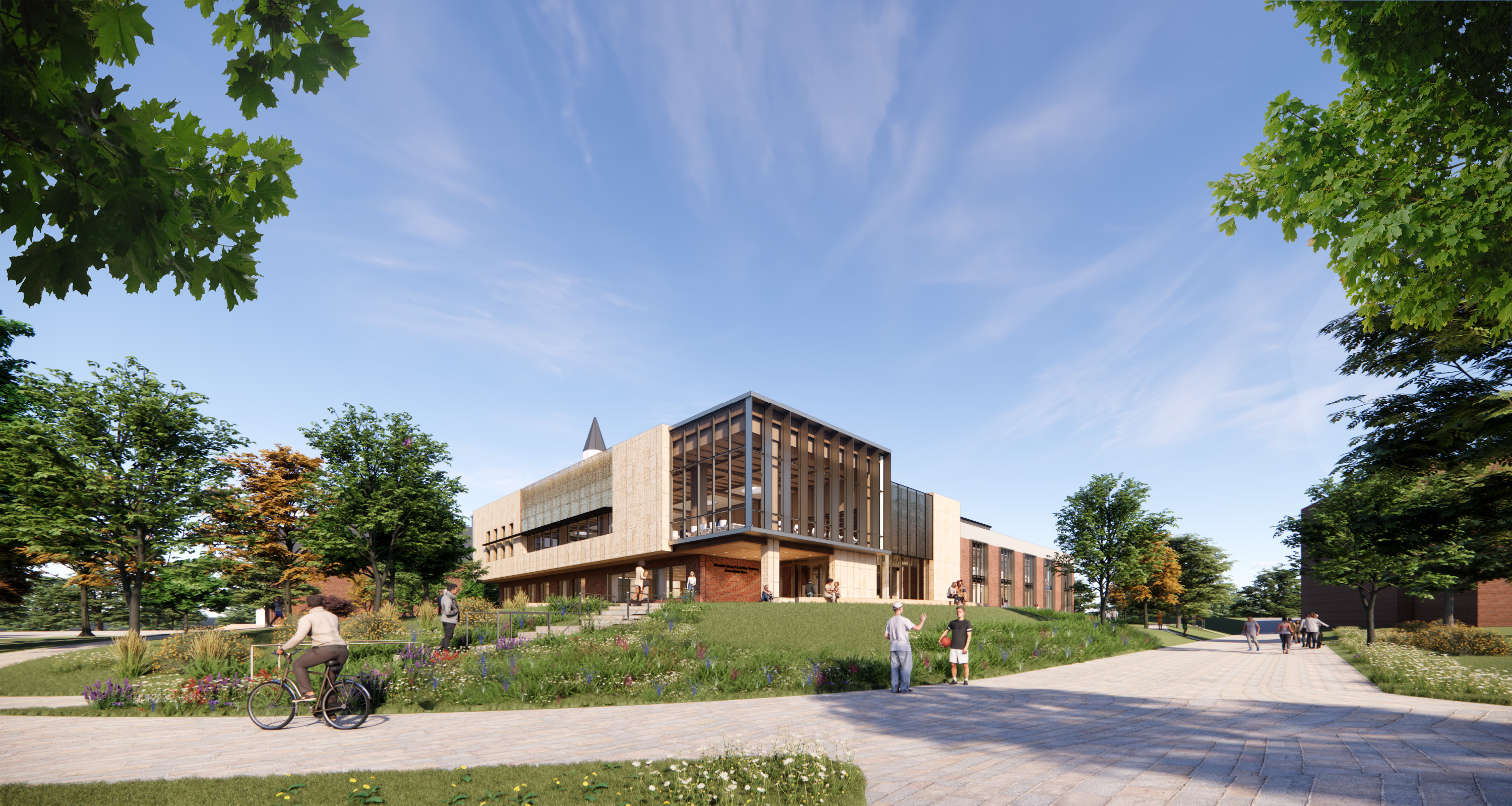
Architect rendering of the southeast corner of the new Wheaton College Library addition.
Dr. Richard Hughes Gibson, Professor of English, is a self-professed big fan of interlibrary loan. “Interlibrary loan stays on its toes for me,” Gibson said. “Our diligent librarians are constantly reaching out to other libraries to find me rare books or technical books of which there are only a handful of copies in the world, or scans of obscure articles in other languages—really hard-to-find resources.”
Case in point: Gibson is currently working on a book about the history of generative AI. He spent his sabbatical in the library, accumulating all sorts of research materials. But he’d run into a puzzle. He needed to locate some books that dealt with word frequencies from the 19th century. “People had done these enormous analyses on how frequently words showed up in hundred-thousand-word collections of books,” he said. “But I couldn’t figure out, first of all, what some of them were even called, and then secondly, how I could get my hands on them.”
It turned out this was just the type of puzzle Wheaton’s librarians were cut out for. Within just a few hours, Gibson got word that the materials had been located.
“My background is in history, and all historians are, to some degree, detectives at heart,” said Associate Professor of Library Science Joshua M. Avery, who has helped Gibson and many others with their research puzzles. “Part of what I most enjoy about being a librarian is bringing those detective skills to bear, alongside a knowledge of the science of information architecture and search systems, to help students develop the persistence and skill to track down the best resources for their questions and projects.”
That’s another key aspect to an effective library—its librarians. Wheaton’s six librarians can teach students to use new technologies, train classes of freshmen how to do research, manage the library’s vast resources, and track down obscure resources for scholars, among other responsibilities.
They work in tandem with the leaders of Wheaton Archives & Special Collections, which contains extensive holdings documenting global evangelism, missions, and Christian history, and the Marion E. Wade Center, which holds a world-renowned collection of seven authors, including C. S. Lewis, J. R. R. Tolkien, and Dorothy L. Sayers, to bring unparalleled scholarly materials to the Wheaton community.
“At the Wade, we have resources that you literally cannot see anywhere else,” Beitler says. “We have annotations by C. S. Lewis in books that he owned, and it’s a bit like reading over his shoulder. A lot of that material is unpublished, so people come from around the world to see what Lewis was writing in his books.”
Select students like Josh Kannard ’26 also help keep the library running. “It is a privilege that I cherish,” Kannard said. “It provides for my education and even helps further it as I acquaint myself with the content available in the library and the type of research developed in various fields—simply by interacting with book covers.”
A library is much more than the multitudes of books it contains. It’s a place to study, of course. At least it should be. A 2021 campus survey to students included a question about their favorite places to study. The most popular responses? Meyer Science Greenhouse, the fifth floor of Billy Graham Hall, the fourth floor of Blanchard Hall, the Office of Multicultural Development (located in the lower section of the Todd M. Beamer Student Center), and even the Game Room, also located in the student center. The library was not in the top five.
There are challenges with those spots. Beamer is a central stopping point for students between classes, and it can be noisy or otherwise filled with activity. The graduate school lounge on the top floor of BGH only seats a couple dozen people at a time. The same goes for Blanchard and the greenhouse. Dorm rooms, too, are places where loud music and video games are frequently present—making them at least sometimes distracting places to study.
Chloe DuBois ’25, an English major who also worked as an archival assistant in the Marion E. Wade Center, studied in the library almost every day, primarily in the mornings and in between classes. But even as a regular, she’d love to see the library make use of more natural light. “Spring of 2024, I studied abroad at Oxford University, where I fell in love with the Bodleian Library’s big windows,” DuBois said. “Oxford’s winter weather (like Wheaton’s) can be miserable, but studying in spaces with natural light helped alleviate my depression.”
The floor plans for the new library, Etzel says, feature ample natural light. A reading room will be the mainstay of the second floor, stretching across the entire south end of the building. New tall windows will offer students a panoramic view of campus, including Blanchard Hall, Adams Hall, and Wheaton’s many trees.
This is crucial, says Melissa Norton, Director of Learning and Accessibility Services. “The kind of rigorous academic work Wheaton students are doing or are called to do really requires those places —places to go do that work. To have somewhere where students can meet up and go study together or solo with an abundance of study spaces and natural light is unparalleled in the ways that it breaks down barriers to success.”
The library will also become a one-stop shop for students to receive additional support in a normalized setting. Currently, the Learning and Accessibility Services office is located across campus at the Student Services Building in a space that cannot accommodate its many functions, like proctoring exams for students with ADA accommodations or peer coaching programs. “It creates some real logistical difficulties that we’re not all in one place, so sometimes we’re running to and from Student Services to the library or the students are winding up at the wrong place for a meeting or exam,” Norton said.
In the new blueprint, LAS offices will be in the library and have ample space for students to meet with one another for peer coaching or taking exams. “We’re super excited to have all that centralized,” Norton said.
Accessibility is also a key factor for external changes to the building. “The architects have been very thoughtful in making the building physically accessible both for someone who is using a wheelchair or someone who is blind,” Norton said, pointing to elements like a sloping outdoor walkway and user-friendly indoor signage and wayfinding for students with or without disabilities.

Architect rendering of the east elevation of the upcoming library expansion.
The Wheaton College Writing Center, led by Senior Lecturer of English Dr. Alison Gibson, is also slated to get a refresh. This center enables undergraduate and graduate students across disciplines to work one-on-one with trained writing consultants to grow and develop effective writing skills. But in its current location, tucked around a corner of the library’s main floor, past a largely unused computer lab, the Writing Center can be difficult to find. It is also a cramped space, which can be inaccessible for some students seeking writing support.
“Writing is a vulnerable act, and it’s even more vulnerable to show someone your writing,” said Alison Gibson, who also serves as the director of first year writing. “The Writing Center needs to be visible and accessible to all students so they feel welcome receiving the help they need.”
In the new layout, the Writing Center will move from its hideaway to a high-traffic location on the main floor, right across from the circulation desk. The new space will include three consultation rooms, large enough for a small table and two chairs, or even a loveseat and a coffee table. Builders will also construct a larger meeting space that can accommodate up to 30 people and be used for lectures, classes, and other gatherings.
During the 2024–25 academic year, the Writing Center held 1,742 half-hour appointments. Gibson imagines those numbers will soar when the renovation is complete. “If we believe that Christians are called to be storytellers, and if we expect Wheaton students to develop effective writing skills during their time here, then we need to give them inspiring spaces in which to do it, as well as ample support,” she said.
Organic meetings and collaborations will be enhanced in a redesigned space, too. With clusters of tables and chairs, collaboration rooms, and an in-house café, students will have comfortable spaces to collaborate on their projects, which may or may not include the need for various technologies. “Increasingly, students are expected to work together, and the library should be the ideal spot for that,” Etzel said.
For example, more and more campus libraries have audio or visual recording spaces for students, as well as spots equipped with monitors where students can work together on presentations. The new floor plan has designated spaces for technologies like these, encouraging group projects and other collaborative work. “A library is a place where students can learn how to use those resources and access them together,” Etzel added. “We want to honor our students and collections with an appropriate building that meets the needs of both.”
In other words, Wheaton already has this vast, nation-leading collection of books and resources and a team of sharp, friendly librarians and patrons. It just needs an elevated space to accommodate it all and function more effectively.
Looking ahead, Richard Gibson likens the ideal traffic flow and activity hub of the library to an airport. “An airport, like a good library, is a place where people arrive and depart,” he said. “It’s a physical center that mediates all of these vast excursions and convergences. It makes such a difference if an airport or a library is spacious and accommodating or if it’s tiny and poorly resourced. When the people who work there are knowledgeable and well-resourced, it’s a wonder.”
Help build the new Wheaton College Library expansion.